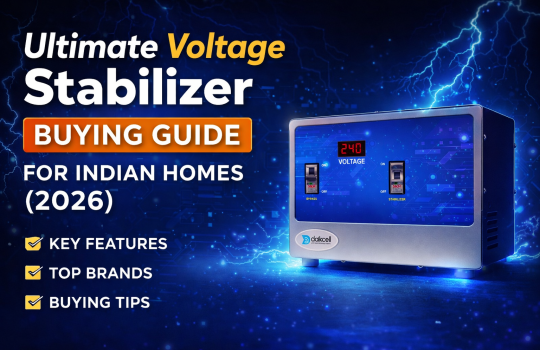
There are many electrical appliances in homes and businesses today, and they comprise far more than simple machinery. Every modern device, including smart TVs, refrigerators, air conditioners, and even medical devices, need stable voltage in order to function safely and efficiently. This is where voltage stabilizers become critical. However, many customers ask, why do voltage stabilizers cost different amounts? By answering this question, customers are able to make more informed decisions rather than purchasing simply because the stabilizer is cheap.
This guide shows the research done on voltage stabilizer pricing and explains how to efficiently allocate one’s resources to receive the highest possible benefit.
Why the Voltage Stabilizer Price is Important
At first, a stabilizer may appear to be a simple box that connects to your appliances and the power supply. However, this is far from the truth. It serves a critical function: protecting your devices from voltage variation, sudden voltage spikes, and even under voltages that may impact the performance and may also cause irreparable damage.
Understanding that a lower stated price for a voltage stabilizer is not always a good idea is also important. With a failure to protect the device, the cost of repairing or replacing the device may be much higher than the cost of the stabilizer. This explains why considering voltage stabilizer prices is really about considering the right balance between initial expenditure and the safety of the device in the future.
What is a voltage stabilizer and how does it work?
An apparatus that counteracts voltage discrepancy is called a voltage stabilizer. The voltage coming from the plug changes, and the stabilizer compensates for the change by adjusting the voltage to the level that is safe to use and provide to the appliance.
Transformers, control circuits, and relays, are some of the inner components of a stabilizer. There is also the possibility of a digital display. The technology, quality, and skill of the constituent parts combined with component technology often dictate the cost of a stabilizer.
Main Characteristics to Consider Voltage Stabilizer Market
- kVA Rating
A major contributor to stabilizer cost is kVA rating. The kVA defined a range of supported appliances, or load, that the stabilizer was built to contain. For example, a stabilizer designed for a single television would cost less than a stabilizer built for a heavy-duty air conditioner or an entire home.
More powerful stabilizers incur additional costs, owing to the fact that more powerful stabilizers use larger or more expensive internal components.
- Categories Of Technology
There are different types of stabilizers like relay-based, servo-controlled, and static. Relay-based types are cheaper and used for basic household needs. Whereas, servo-controlled types provide more accuracy, and therefore, their stabilizer price is more because they are used for more sensitive equipment and industrial equipment.
More advanced technology is typically used for faster response time and better accuracy for voltage, and this is more expensive.
- Quality of Components and Construction
The quality of the internal components of a stabilizer has a big impact on the performance and durability of it. Higher quality materials like advanced circuit boards, better transformers, and more expensive copper windings will outperform their cheaper counterparts.
When the price of a stabilizer is cheaper, this is usually a sign that the materials they used are of lower quality. Because of this, overheating, noise, and a shorter lifespan are often seen. It is often better to have the cheaper alternative because this improves the lifespan of the stabilizer and saves money in the long run.
- Range Of Input Voltage
Stabilizers that are more expensive are often designed for a more broad range of input voltage. This becomes more important in regions with a wider range of voltage.
On the other hand, the stabilizer with the narrower operating range is more likely to contribute to the heating and damage of appliances that are exposed to extreme voltage. This factor becomes more important for consideration in determining the price of voltage stabilizers in places with high voltage fluctuations.
- Value and Certification of the Brand
The reputation of the brand and the safety certifications also matter when determining the price of a stabilizer. The manufacturers who invest in testing, compliance, and quality control are more costly.
Stabilizers that are certified and meet the safety standards and the guidelines for performance, give you peace of mind. Even though they are more expensive, they reduce the risks of electrical faults and failures.
Stabilizer price ranges explained
Budget Range
Budget range stabilizer models are fitted for small practices with less power consumption. They protect you just enough so that they can be sold. The models may not adequately handle ranges that are more extreme or more frequent when it comes to fluctuating power.
Mid-range models
Stabilizers in this range provide a better compromise between price and performance. They are likely to provide better and more durable components that push the encapsulated range to a wider upper limit. Most households will find the best value in this price range.
Premium models
Premium models provide protection for the best appliances, commercial protection, or protection for entire buildings. The range of price and performance of the devices is relatively high. The stabilizer prices and the level of protection, and reliability are equal.
Long-Term Value vs. Hidden Costs
When considering the price of a stabilizer, the sticker price alone should not be the only consideration. A lower cost stabilizer tends to fail more often, leading to repair costs, appliance damage, or downtime.
In contrast, a moderate cost stabilizer often operates more efficiently, requires fewer repairs, and lower maintenance costs. Quality protection offers the best value over time, as economically priced stabilizers lead to hidden costs.
How Stabilizer Price Affects Appliance Lifespan
Reduced voltage and steady supply helps to relieve stress from the electrical components inside appliances. The smooth operation of motors, the protection of electronic circuits, and the maintenance of consistent appliance performance are all benefits of a stable supply of voltage.
A stabilizer priced too low runs the risk of poor voltage correction, resulting in degradation of your appliances. Costing the right price is an investment, and in the long run, it saves energy.
How To Pick The Best Stabilizer Without Paying Too Much
Select the capacity that meets the requirements of your appliances to avoid overpaying on too large of a model, or under performance on a too small model.
Evaluate your country’s power supply conditions in order to select the stabilizer that meets your needs, as the input voltage can vary.
When faced with multiple options for the same price, always choose the stabilizer that meets your needs instead of settling for the lowest priced option. Choose the stabilizer with the power monitoring digital display, an over-temperature thermal protection to prevent overheating, and an automatic cut-off feature.
Even with the added cost of a higher quality stabilizer, the warranty that comes with it is worth it at a higher price.
If you are considering a low price stabilizer to save costs, keep in mind that it may offer too many features that are unnecessary for your basic use.
Final Insights:
Paying Smart, Not Just Paying Stabilizing the voltage ensures safety, reliability, and peace of mind. Knowledge of the value inexpensive items can help you avoid spending money on poor-quality items.Don’t look for the absolute minimum price, look for the absolute most value. A stabilizer that is a good choice will protect your appliances, reduce costs over the life of the stabilizer, and protect your appliances from poor performance. When it comes to safety in electricity paying less is always a bad option.