AC Voltage Stabilizer vs Servo Voltage Stabilizer: Which Is Right for You?
Areas with especially high power demand and older electrical infrastructure often have issues with fluctuating voltage levels. Such voltage fluctuations can cause a number of problems that can go unnoticed until damage is done. Electrical appliances can have their efficiency reduced and their operational lifespans shortened. This is where voltage stabilizers become very important. Two of the most popular products in this category are the traditional AC stabilizers and the servo AC stabilizers. Stabilizers all have the same core purpose of providing and maintaining stable voltage. That being said, they each have their own individual areas of work, applications, and usefulness that vary significantly from each other.
This is to inform the audience about what each type does, what is their most optimum use and location, and in that case how to determine which type is the most applicable for their needs.
Why Voltage Regulation Matters
It is well documented that every electronic device is created to run at a certain range of voltage. If the provided electricity is outside of that range, that can cause overheating, breakdown of individual components, loss of information, or even irreparable damage. More delicate devices like air conditioning units, refrigerators, and some medical devices or IT systems are even more susceptible to harm.
A voltage stabilizer keeps the output voltage to your equipment within a range which is acceptable, no matter how much the input supply varies.
Understanding an AC Voltage Stabilizer
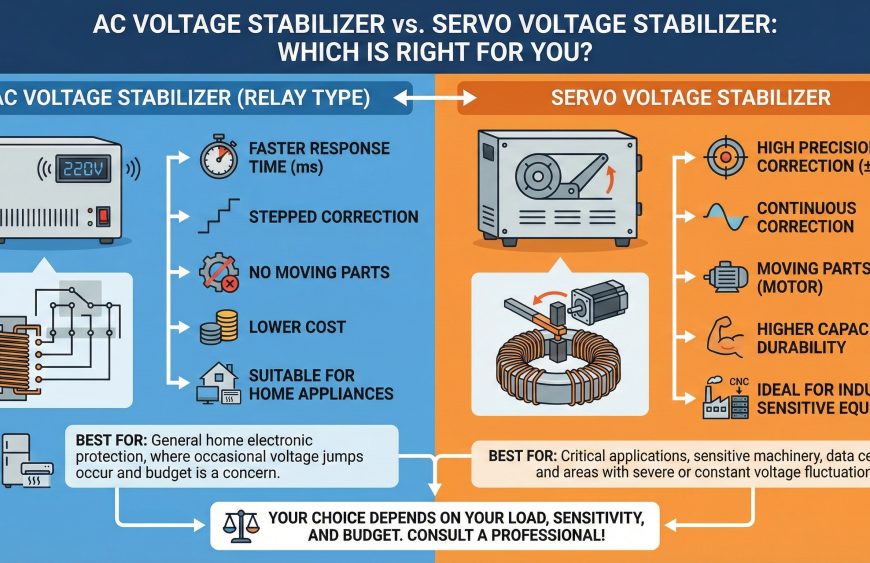
An ac voltage stabilizer is generally a static piece of equipment that employs various electronic technologies such as circuitry, relays, and tap changing transformers to accomplish voltage regulation. It recognizes fluctuations in the incoming power and changes the output voltage by engaging the various taps of the transformer.
How It Works
The stabiliser senses fluctuations in the input voltage. Controlled internal relays are then activated. These switch the transformer taps to adjust the voltage. The voltage can be increased or decreased based on the configuration. The corrections are incremental.
Key Characteristics
- Step-based voltage correction
- Relatively simple design
- Faster response compared to older manual stabilizers
- Lower cost and maintenance
Common Applications
Such stabilizers can be observed in many homes. Such appliances as televisions, refrigerators, washing machines, and split system air conditioners use this kind of protection.
Advantages
- Affordable and easily available
- Compact size
- Adequate protection for household appliances
- Low power consumption
Limitations
- Voltage correction is not extremely precise
- Not ideal for highly sensitive or industrial equipment
- Relays may wear out over time due to frequent switching
Understanding a Servo Voltage Stabilizer
With the help of a servo motor mechanism, a servo voltage stabilizer is able to achieve constant and exact voltage correction. This type of stabilizer is unlike step-based stabilizers, as it adjust voltage gradually and in an accurate manner, which is essential for important applications.
How It Works
The device constantly assesses the output voltage. After an asymmetry is identified, a servo-controlled motor turns a variac to real-time alter the output voltage. This maintains the system’s correct output with a high degree of accuracy.
Key Characteristics
- Continuous voltage correction
- High accuracy (usually within ±1%)
- Robust electromechanical design
- Suitable for heavy loads
Common Applications
Per industrial, commercial, and medical applications, equipment like CNC machines, elevators, printing presses, diagnostic devices, servers, and lab instruments are safeguarded by stabilizers with servomotor control.
Advantages
- Extremely precise voltage control
- Handles wide input voltage ranges
- Ideal for sensitive and high-capacity equipment
- Longer equipment life due to stable output
Limitations
- Higher initial cost
- Larger size compared to household stabilizers
- Requires periodic maintenance of mechanical parts
Key Points of Comparison
1. Accuracy of Voltage Regulation
Ac stabilizers have discrete cascaded voltage regulation. As such, there may be output ripple within an acceptable range. At the same time, servo voltage regulation predetermines them for applications that require precision, as the output ripple is virtually eliminated.
2. Application Scope
For most common household usages, a normal stabilizer is adequate. In industrial arrangements or situations that contain delicate electronics, more accuracy is required, and it’s here that servo-controlled devices excel.
3. Load Handling Capacity
Devices created to handle lower loads are called residential stabilizers. Conversely, Some servo stabilizers can manage high capacity loads and may range from a few kVA to several hundred kVA.
4. Cost Considerations
Basic AC stabilizers command a lower initial investment, which drives their popularity for home applications. Though servo stabilizers have a greater initial cost, they very often save money over time due to their lower risk of equipment damage and downtime.
5. Maintenance Requirements
Mr. Garrison further elaborated that devices like static stabilizers have fewer movable components which leads to lower maintenance requirements. For servo stabilizers, which contain motors and other mechanical devices, maintenance inspections and services are required at regular intervals.
How to Choose the Right Stabilizer
Choosing the right stabilizer depends on several practical factors:
Nature of Equipment
When it comes to standard household appliances, a basic stabilizer should suffice to meet your needs. However, if the equipment is sensitive to even the slightest voltage fluctuations, then a more advanced solution should be considered.
Voltage Fluctuation Severity
Standard stabilizers function effectively in regions with low voltage variations. For areas with extreme or frequent fluctuations, continuous correction systems are beneficial.
Load Capacity
Power consumption of required equipment should be calculated prior. It is advisable to select a stabilizer Rated capacity a little higher than required to guarantee safety and effective operation.
Budget vs Long-Term Value
Although initial costs are of concern, take into account the long-term effects. An investment in accurate voltage regulation has the potential to save significant costs related to equipment failure, repairs, and reliability of operations.
Use Case Scenarios
- Homes and Small Offices: Ideal for televisions, refrigerators, and air conditioners where voltage variation is moderate.
- Commercial Establishments: Retail outlets, diagnostic labs, and data centers benefit from stable and accurate voltage control.
- Industrial Units: Manufacturing plants with automated machinery require continuous eand precise voltage adjustment to avoid downtime.
Final Thoughts
While both varieties of stabilizers are aimed at safeguarding electrical devices, which stabilizer is more appropriate really comes down to the specifics of the case scenario at hand. Knowing the functionality, efficacy, and compatibility of each option will aid the consumer in choosing wisely.
A conventional option will be more than adequate if the consumer needs something inexpensive and will only be protecting devices of lower value. However, if keeping expensive devices safe, reliability, and precision are important the more expensive option of a servo-controlled system will pay off in the long run.
There is no question that the appropriate stabilizer of the possible options will not only keep devices safe, but also ensure that the consumer is able to work more efficiently, the appliances will be able to function for a longer period, and will be more at ease when working.