ACs are currently the most electricity-consuming electrical equipment in the household. They give comfort in extremely hot and cold of climate seasonal temperatures, climates and weather, weather but are extremely vulnerable to changes in power supply stability. An unstable power supply can ruin internal systems and functions mechanisms, cripple cooling functionality, and significantly increase the total consumption of cooling power. To avoid this, choosing the best voltage stabilizer is not an optional accessory but an indispensable protective shield. This is to serve as an educational guide for everything necessary to choose wisely and for the house.
Understanding Why Your AC Needs a Stabilizer
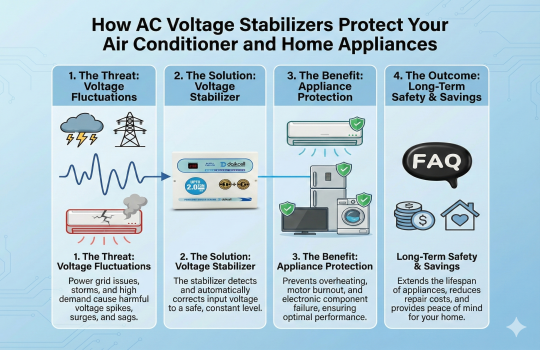
Residential voltages vary because of full power line usage, seasonal demand, and grid supply disruptions. Each mini-split air conditioner runs with a compressor, motor, and control board. Each of these devices needs a consistent voltage supply to work properly. A voltage drop to the compressor causes overheating, while over voltaging damaging the control board’s circuitry. A stabilizer protects those devices and allows the AC to receive voltage consitently, regardless of the external fluctuations.
Know Your AC Type and Power Requirements
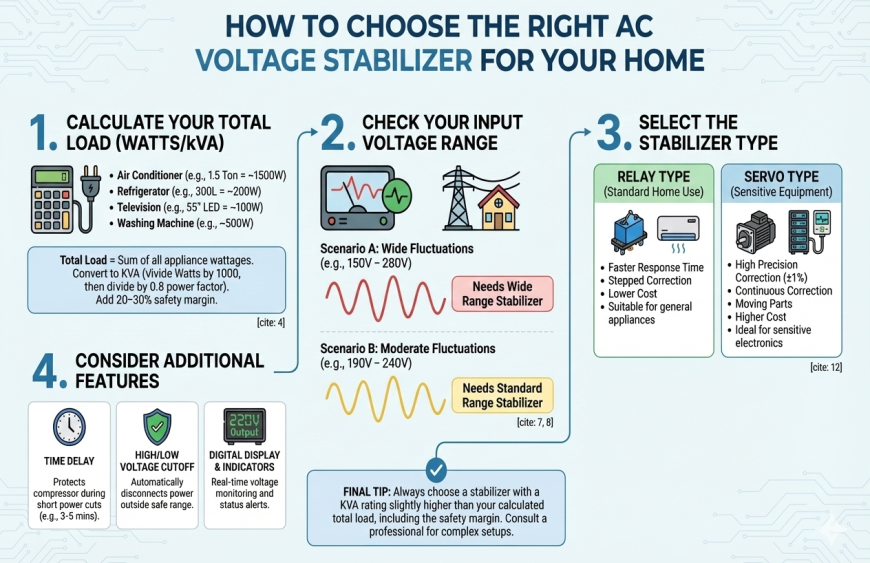
Before buying a stabilizer, you should get to know the specifics of your air conditioning unit. Split, inverter, and window air conditioners all have different power requirement. For example, inverter air conditioners already have some voltage toleration, but in highly volatile areas, they still require some outside protection. Reviewing the power consumption, tonnage, and the rated voltage range will help you hone in on compatible stabilizer.
Perhaps the most important aspect is choosing the correct power rating. Many homeowners make the mistake of getting a stabilizer with too low of a rating. This will cause overheating and destabilizer failure. To choose stabilizer capacity correctly. You need to know the total wattage of your AC, so you can choose a stabilizer with a little higher capacity than that to ensure a smoother operation. This is especially important during peak load operation. Overall, it will mean better efficiency and longer lasting capability of stabilizer’s peak capacity.
Input Voltage Range Matters More Than You Think
Voltage variations differ from area to area. Some locations will experience very minimal drops, whereas others will undergo drastic highs and lows. Always check what input voltage range is supported by the stabilizer. If the stabilizer has a wider input range, it will be able to withstand severe fluctuations. If the voltage levels in your locality are erratic, a stabilizer designed to operate on a wide range will give you better protection and will allow cooling to remain uninterrupted.
Energy Efficiency and Power Consumption
The stabilizer is also used continuously every time the air conditioning system is used, and its power consumption also is also a consideration. It is also the case that without highly energy-efficient stabilizers, consumption of energy which would otherwise be wasted will be kept to a minimum and steady output of equal voltage will be achieved. Lowest loss devices and optimally designed transformers are used to counter the protection of these devices from energy loss and to keep high costs of energy.
Features That Enhance Performance and Safety
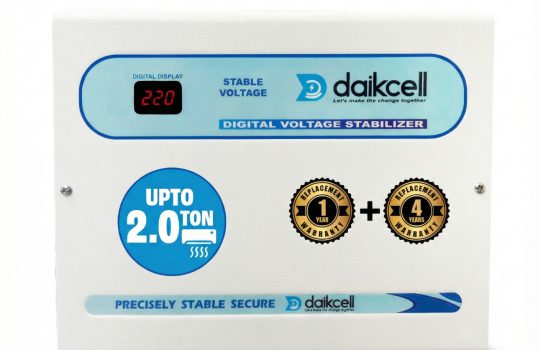
Modern stabilizers have features that go far beyond simple voltage correction. To protect the compressor, time-delay systems allow the voltage to stabilize before restarting the stabilizer. Then there’s the thermal overload protection, which helps prevent overheating by turning the stabilizer off. And of course, there are digital displays that show the voltage in real time. When searching for the best stabilizer for ac use in the home, these elements are very beneficial for safety, convenience, and overall long-term use.
Build Quality and Installation Considerations
A stabilizer must also be able to handle uninterrupted functioning throughout the extended summer months. Prioritize stabilizers with superior transformers, rugged container construction, and sound design of air exchange pathways. Stabilizers that can be installed against least walls are more space efficient and can provide more effective air flow. For safety and efficient functioning, custom fitting of stabilizers by professionals is also advocated.
Budget vs Long-Term Value
Presumably, the primary factor in your decision-making process is the price of the product. While at times a low price is enticing, other aspects of the product should be taken into consideration. Saving money at the expense of quality could lead to broken stabilizers and unhappy customers, not to mention the costs associated with broken Air Conditioners. Saving money on a stabilizer with a good enough quality could pay off in the long run, making it a sound investment.
Making the Final Decision
An appropriate stabilizer should consider all three factors: capacity, protection level, and durability. If you follow a defined stabilizer selection procedure that encompasses understanding your AC requirements, evaluating your area’s voltage conditions, and considering safety features, you will be able to make an informed decision. The appropriate stabilizer will not only protect your air conditioning unit, but also provide uninterrupted cooling, conserve energy, and give you peace of mind all year round.